Looking for an OpinionPadi Alternative in Nigeria?
For businesses launching a new product, improving an existing service or entering a new market, getting feedback from real customers can be incredibly valuable.
A company may want to know whether people understand its product, how customers feel about its brand or whether a new feature is actually useful. A startup may want to test its app before launch, while a research team may need hundreds of Nigerian respondents for a consumer study.
OpinionPadi has built its platform around this idea. It connects businesses and product builders with Nigerians who can provide opinions, test products and participate in research. Its business offering currently includes surveys, product testing, feedback collection and targeted research, with the company saying it covers all 36 Nigerian states.
For employers looking specifically for Nigerian consumer insights, that can be useful.
But not every business campaign is simply a survey or feedback exercise.
Sometimes you need people to complete a specific task, test an application, visit a website, collect information or perform several actions before giving their feedback.
That is where TaskPay.ng offers a broader alternative for employers.
What Is OpinionPadi Used For?
OpinionPadi is positioned around consumer feedback and market research.
Its platform allows businesses to reach Nigerian participants for activities such as surveys, product testing, customer feedback and market research. The company also promotes demographic targeting, real-time analytics and research campaigns for brands, startups and researchers.
This can be valuable when the main objective is to understand what Nigerian consumers think.
For example, a company launching a new product might ask consumers whether they would buy it.
A brand might measure awareness before and after a campaign.
A startup could ask users to evaluate a new feature.
A researcher could recruit respondents for a structured survey.
But employers sometimes need something that goes beyond asking questions.
When Feedback Needs to Start With an Action
Imagine a Nigerian fintech company preparing to launch a new mobile application.
The company wants 500 Nigerians to download the application, create an account, navigate through several screens and test a particular feature.
Only after completing those steps should participants answer questions about their experience.
The employer is not simply looking for opinions.
It needs people to perform a defined task and then provide feedback.
That is an important distinction when choosing between a research-focused platform and a broader microtask marketplace.
TaskPay.ng: A Broader Option for Employer Campaigns
TaskPay.ng is designed around a straightforward concept: businesses have tasks that need to be completed, and workers can complete those tasks through the marketplace.
An employer can create a campaign, explain what workers need to do, establish the requirements and specify the appropriate proof of completion.
Workers then complete the assignment and submit their work for review.
According to the worker figure supplied for TaskPay.ng's employer marketing, the platform has access to 500,000+ workers.
For employers running large Nigerian campaigns, access to a substantial worker pool can make it easier to move from finding a handful of participants to running a campaign involving hundreds or thousands of people.
The difference is that the employer can structure the campaign around the actual outcome it needs, rather than limiting the campaign to a questionnaire.
Why Nigerian Participants Matter
OpinionPadi's focus on Nigerian consumers highlights an important point: local feedback can be extremely valuable.
A business targeting Nigeria needs to understand the people who actually live and shop in that market.
Nigerian consumers have their own payment preferences, purchasing habits, mobile usage patterns and expectations around products and services.
A fintech company testing a payment experience, for example, benefits from feedback from people who actually use the financial services available in Nigeria.
An e-commerce company may want Nigerian shoppers to test its checkout process.
A Nigerian startup may want people from different parts of the country to evaluate its product.
For these businesses, local participation is more than a demographic preference. It can directly affect the usefulness of the results.
TaskPay.ng is built around connecting employers with Nigerian workers, making it an option for campaigns where local participation matters.
Surveys and Market Research
There is still an important role for surveys.
A business may want to understand how consumers perceive its brand, what they think about a proposed product or which features they value most.
For example, a company could ask Nigerian participants:
Would you purchase this product?
Which price would you consider reasonable?
Which feature is most important?
Which competitor are you currently using?
What would make you switch brands?
The answers can provide valuable information for product development and marketing decisions.
TaskPay.ng can be used to create legitimate survey and research campaigns, while also allowing employers to combine questions with other task requirements where appropriate.
Product Testing Before Launch
One of the biggest advantages of getting real people involved early is discovering problems before they become expensive.
A development team may believe its application is easy to use because the team knows how everything works.
A first-time user does not have that advantage.
An employer could create a TaskPay.ng campaign asking Nigerian participants to complete a specific journey through the application.
They might need to register, find a particular feature, complete a transaction or navigate through several screens.
Afterwards, participants could explain what was easy, what was confusing and whether they encountered any problems.
The employer can then identify recurring issues.
This turns user testing into something more practical than simply asking people whether they like the product.
Website Testing and User Experience
The same principle applies to websites.
Suppose an online retailer has redesigned its website.
Before sending thousands of visitors to it through advertising, the business wants to make sure ordinary customers can actually use it.
Participants could be asked to find a product, compare two items, navigate to checkout and report their experience.
If multiple people struggle with the same step, the business has a clear indication that the website may need improvement.
For Nigerian businesses, using Nigerian participants can make these results more relevant to the actual customer base.
Research Beyond Surveys
Not every research project needs to be a traditional questionnaire.
An employer may want people to compare two advertisements, review a product concept, evaluate a landing page or provide feedback after using a service.
These activities can be structured as tasks.
This is where a microtask marketplace gives employers flexibility.
Instead of asking participants only to answer questions, the employer can design a campaign around an activity and then collect feedback based on the participant's experience.
That can produce more practical insights because participants are responding to something they have actually seen or used.
Data Collection and Online Research
Businesses also have information that needs to be collected and organised.
A company may need workers to research publicly available information, verify details, categorise data or complete structured forms.
If the project is large, assigning everything to one person can be inefficient.
A microtask marketplace allows the employer to break the project into smaller assignments and distribute them across multiple workers.
This makes it possible to handle larger volumes of repetitive work without building a temporary research team internally.
Why Proof of Completion Matters
For employers, recruiting workers is only half the job.
The business also needs to know whether participants actually completed the requested work.
That is why clear task instructions and proof requirements are important.
An app-testing campaign might require screenshots and written feedback.
A survey might require completed responses.
A research task could require the information collected by the worker.
A website-testing campaign might ask participants to explain their experience.
TaskPay.ng's task-and-proof approach gives employers a structured way to define these requirements and review submissions.
This becomes increasingly important as the number of participants grows.
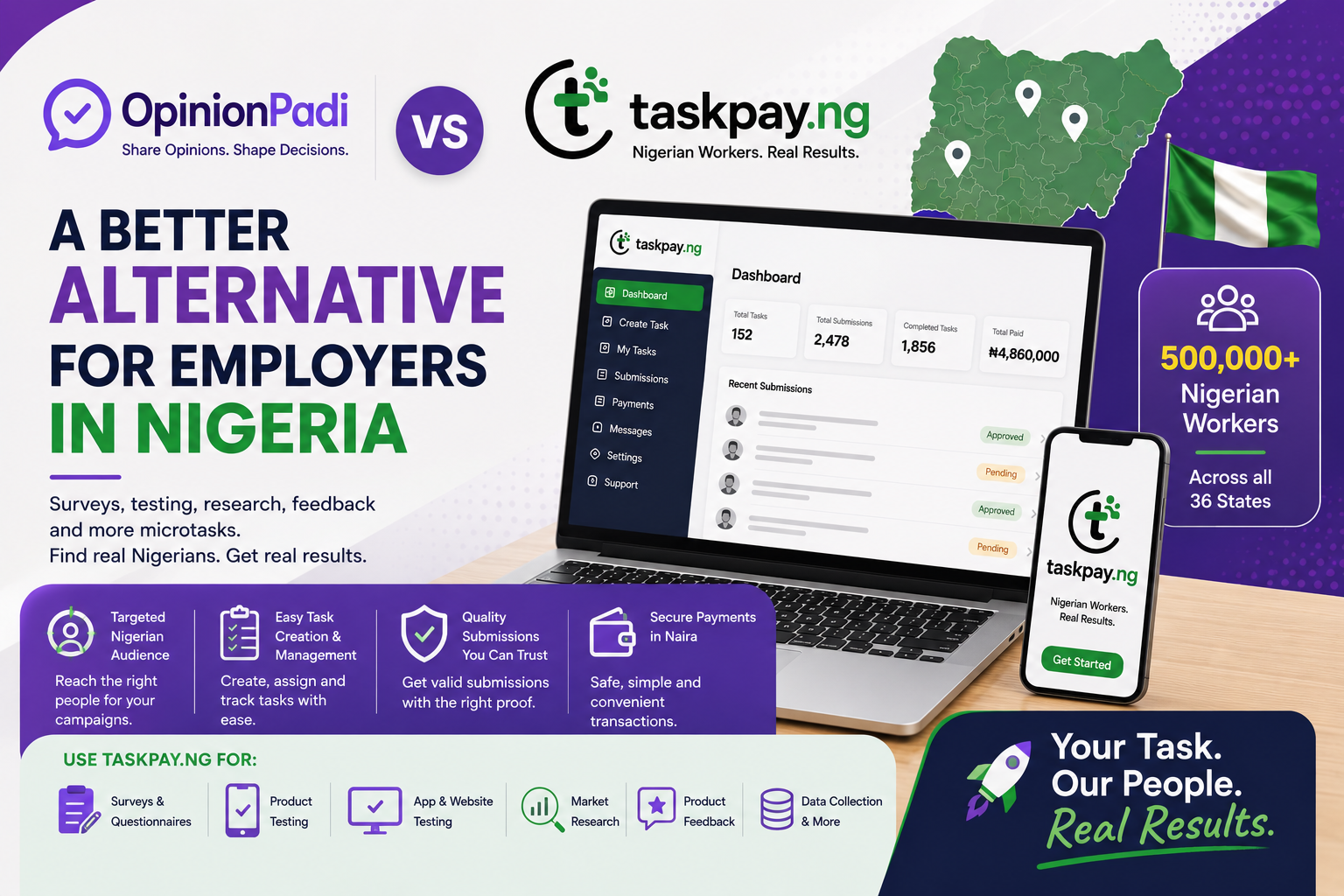
OpinionPadi vs TaskPay.ng
OpinionPadi and TaskPay.ng both focus on connecting Nigerian businesses with people who can participate in digital campaigns, but their positioning is somewhat different.
OpinionPadi is strongly centred on consumer insights, surveys, product testing and targeted market research. Its current business platform highlights demographic targeting, verified participants, analytics and research use cases.
TaskPay.ng is positioned more broadly around the microtask marketplace model, where employers create defined tasks and workers complete them according to specific instructions.
That distinction can be useful when choosing a platform.
If you need a structured market research project with targeted respondents, OpinionPadi may be relevant.
But if your requirement is:
“I need 500 Nigerians to test my app, complete these steps, provide feedback and submit proof.”
then TaskPay.ng can be a compelling alternative.
Who Should Consider TaskPay.ng?
TaskPay.ng can be useful for a wide range of Nigerian employers.
Startups can use it to validate products before launch.
App developers can recruit Nigerian beta testers.
Fintech companies can conduct user research.
E-commerce businesses can test websites and gather customer feedback.
Marketing agencies can recruit participants for client campaigns.
Researchers can create survey and data-collection tasks.
Businesses can also distribute repetitive online research work across multiple workers.
Final Thoughts
OpinionPadi has built a platform around an important business need: helping companies hear directly from Nigerian consumers. Its current offering covers surveys, product testing, feedback and targeted market research.
But employers don't always need opinions alone.
Sometimes they need people to use a product.
Sometimes they need people to test an application.
Sometimes they need people to research information.
Sometimes they need people to complete a series of actions and then provide feedback.
And sometimes they need hundreds or thousands of Nigerians to complete the same clearly defined task.
That is where TaskPay.ng offers a different proposition.
With access to 500,000+ workers, a Nigerian-focused marketplace and an employer-oriented task workflow, TaskPay.ng gives businesses another way to reach Nigerian workers and organise campaigns at scale.
So, if you have been searching for an OpinionPadi alternative in Nigeria, particularly for surveys, product testing, market research, app testing, website testing, data collection or other legitimate microtasks, TaskPay.ng is worth considering.
Ready to Reach Nigerian Workers?
Create your task, explain exactly what you need and put your campaign in front of Nigerian workers.
Start your next campaign on TaskPay.ng.
TaskPay.ng — Your task. Nigerian workers. Real results.