Looking for a Surveytime Alternative in Nigeria?
When businesses need to understand what customers think, surveys are often one of the easiest places to start.
A company preparing to launch a new product might want to ask potential customers whether they would buy it.
A marketing team may want to test different advertising messages. A startup could be looking for feedback on a new business idea, while a research company may need hundreds of respondents for a consumer study.
A marketing team may want to test different advertising messages. A startup could be looking for feedback on a new business idea, while a research company may need hundreds of respondents for a consumer study.
Surveytime is one of the platforms built around online surveys. It describes itself as a global paid-survey platform where users complete surveys matched to their profiles and receive rewards for successful participation.
For businesses conducting straightforward consumer research, this type of survey ecosystem can be useful.
But employers sometimes need more than survey answers.
They may need people to test an app, visit a website, research information, evaluate a product or complete a series of actions before providing feedback.
That is where a broader microtask marketplace can become more useful.
For employers specifically looking to reach Nigerian workers, TaskPay.ng is an alternative worth considering.
What Is Surveytime?
Surveytime is primarily focused on paid online surveys. Users create a profile, receive surveys that match their interests and complete them in exchange for rewards. Surveytime says its service is global and that surveys are matched according to users' profiles.
The platform is therefore particularly relevant to organisations that need consumer opinions.
A research company could use surveys to understand purchasing habits. A brand could test reactions to a product. A marketing team could gather opinions about advertising or customer preferences.
The model works well when the main question is:
“What do consumers think?”
But employers often have another question:
“What happens when consumers actually use our product?”
That requires something beyond a questionnaire.
Why Employers May Look for a Surveytime Alternative
Consider a Nigerian fintech company that has just developed a new mobile application.
The company wants 500 Nigerians to download the app, register, explore a particular feature and then answer questions about their experience.
The survey is only part of the campaign.
The employer first needs participants to perform an action.
The same thing could happen with a website.
A company may want Nigerian users to visit its website, find a product, navigate through the checkout process and report anything confusing.
An e-commerce business might want consumers to compare two product pages.
A startup might want potential customers to test a new service.
These are all tasks that can include surveys, but they are not limited to surveys.
This is where TaskPay.ng offers a different approach.
TaskPay.ng: Beyond Traditional Surveys
TaskPay.ng is a Nigerian microtask marketplace that allows employers to create clearly defined tasks and connect them with workers who can complete them.
Instead of creating only a questionnaire, an employer can explain exactly what participants need to do.
The task can include instructions, requirements and appropriate proof of completion.
Workers complete the assignment and submit their work for the employer to review.
According to the worker figure supplied for TaskPay.ng's employer marketing, the platform has access to 500,000+ workers.
For an employer running a Nigerian campaign, that creates a substantial potential pool of participants.
More importantly, it allows the employer to structure a campaign around the actual business objective, rather than limiting the campaign to a survey.
Why Nigerian Participants Matter
Surveytime is global, and that can be useful when research requires an international audience. Its own platform states that surveys are available across countries and can be accessed from desktop and mobile devices.
But global reach isn't always the most important factor.
If your customers are Nigerian, you may want your research participants to be Nigerian too.
Local consumers understand local payment methods, shopping habits, mobile usage, pricing expectations and cultural context.
A Nigerian fintech company, for example, may learn more from Nigerian users testing its payment experience than from participants who have never used the financial services available in the country.
Likewise, a Nigerian e-commerce company may want feedback from people who actually shop within the Nigerian market.
For those employers, a Nigerian-focused worker marketplace can provide a more relevant starting point.
Using TaskPay.ng for Surveys and Research
This does not mean surveys are no longer useful.
Quite the opposite.
Surveys remain an excellent way for businesses to collect opinions from a large number of people.
A company could use TaskPay.ng to recruit Nigerian participants for questions about:
- Product preferences
- Brand awareness
- Pricing
- Customer experience
- Shopping behaviour
- Advertising
- New product concepts
- Website usability
The difference is that the employer can also build additional actions around the survey.
For example, participants could first visit a website and then answer questions about what they experienced.
They could test an application before completing the questionnaire.
They could review a product concept and explain what they liked or disliked.
This can provide richer feedback than simply asking questions in isolation.
App Testing With Real Nigerian Users
For technology companies, one of the most valuable uses of a microtask marketplace is user testing.
Developers spend months building applications, but they are often too familiar with their own products to see every usability problem.
A first-time user approaches the application differently.
An employer can create a TaskPay.ng campaign asking participants to complete a particular journey through an application.
They might need to register, locate a feature, complete a transaction or navigate through several screens.
Afterwards, the participant can provide feedback about the experience.
If several participants struggle with the same feature, the business has a useful signal that the product may need improvement.
For a company targeting Nigeria, conducting this testing with Nigerian users can make the feedback more relevant.
Website and Product Testing
The same approach works for websites and other digital products.
Imagine a business preparing to launch a new online store.
Before spending a significant amount on advertising, it wants to know whether customers can easily find products and complete checkout.
The employer could create a task asking Nigerian participants to perform a specific shopping journey.
Participants can then report where they encountered difficulties.
This kind of testing can uncover problems that may not appear during internal quality assurance.
It can also help businesses understand how real customers perceive their product rather than relying entirely on assumptions.
Data Collection and Online Research
Employers do not always need consumer opinions.
Sometimes they need information.
A company might need people to research publicly available information, verify details, categorise data or complete structured forms.
When the workload is large, assigning everything to one employee can take considerable time.
A microtask marketplace allows the work to be divided into smaller assignments.
Multiple workers can then contribute to the same project.
For example, instead of asking one researcher to investigate hundreds of sources, an employer could divide the research into smaller tasks and have multiple workers handle different sections.
This is one of the fundamental advantages of crowdsourcing.
Why Proof of Completion Matters
When an employer pays people to complete tasks, it needs to know that the requested work was actually performed.
Clear instructions are therefore essential.
An app-testing task might require a screenshot and written feedback.
A research task might require the information discovered by the worker.
A website-testing campaign could require participants to explain their experience.
A survey could simply require completed responses.
TaskPay.ng's task-and-proof workflow allows employers to establish the requirements before workers begin.
That gives businesses a clearer way to evaluate submissions, particularly when a campaign involves hundreds or thousands of participants.
What Can Employers Use TaskPay.ng For?
TaskPay.ng can be useful for many legitimate employer campaigns, including surveys, market research, app testing, website testing, product feedback, user research, data collection, online research and product testing.
Marketing agencies can also use microtask campaigns when they need Nigerian participants for legitimate client projects.
For startups, the platform can provide a way to test ideas and products before investing heavily in a public launch.
For established companies, it can provide an additional channel for collecting customer feedback and distributing repetitive digital work.
The key is to make each task clear and explain exactly what successful completion looks like.
Surveytime vs TaskPay.ng
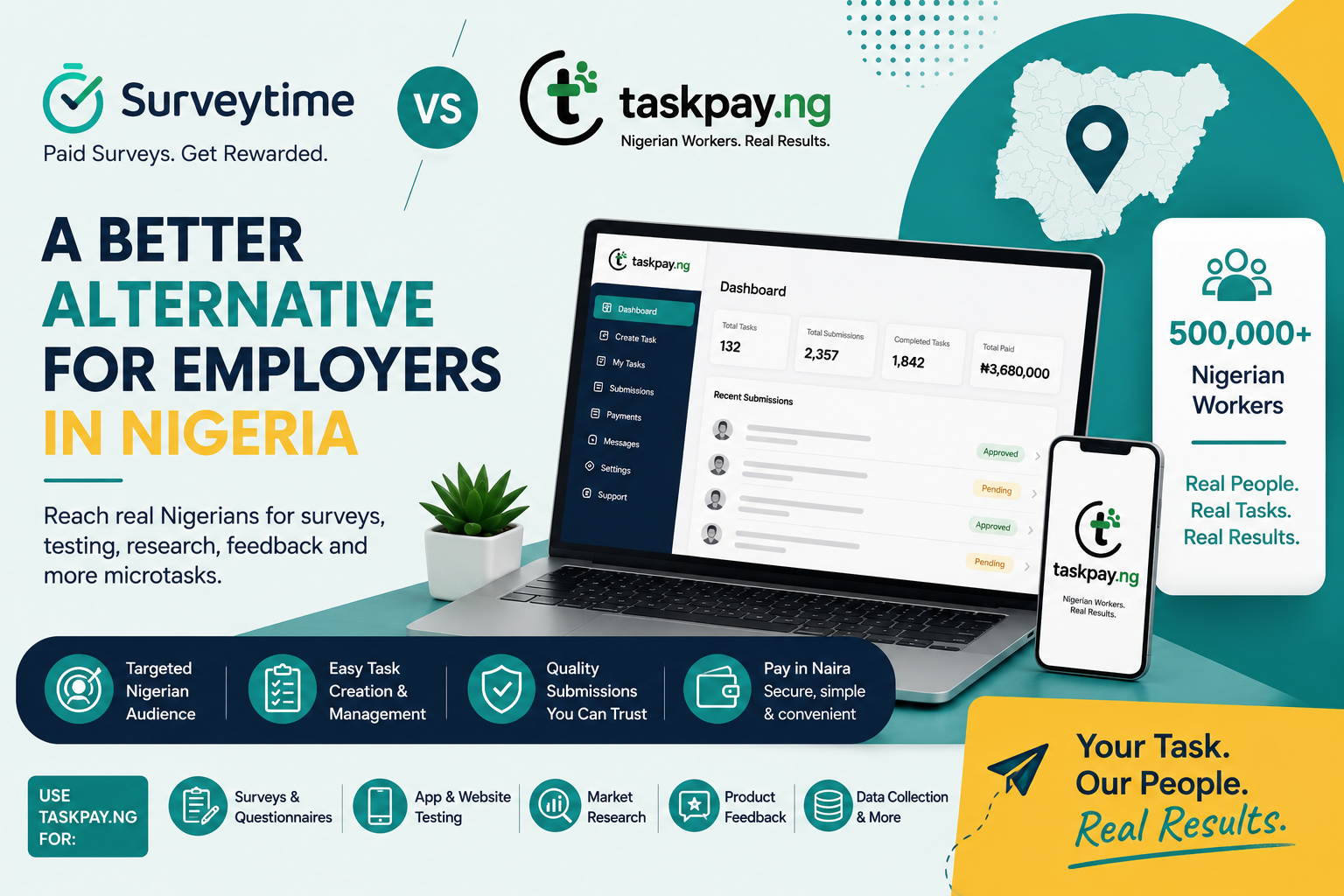
Surveytime is primarily a survey and consumer-rewards platform, while TaskPay.ng is positioned as a broader microtask marketplace for employers.
That distinction matters.
If your company simply needs people to answer a questionnaire, a survey-focused platform can be a suitable option.
But if the requirement is:
“I need 500 Nigerians to test my app, answer questions about it and submit proof.”
then a microtask marketplace can be a more natural fit.
TaskPay.ng also gives employers a way to structure campaigns around activities other than surveys, including testing, research, data collection and product feedback.
Who Should Consider TaskPay.ng?
TaskPay.ng can be particularly useful for employers whose campaigns depend on Nigerian participation.
Startups can use it to test new products.
App developers can recruit Nigerian beta testers.
Fintech companies can conduct user research.
E-commerce businesses can gather customer feedback.
Market researchers can recruit Nigerian survey participants.
Digital agencies can run research and testing campaigns for clients.
Businesses with repetitive online work can also distribute that workload across multiple workers.
Final Thoughts
Surveytime has built its platform around a simple idea: connect people with surveys and reward them for sharing their opinions. Its global model makes it useful for organisations seeking survey respondents across different markets.
But employers do not always need survey responses alone.
Sometimes they need people to use a product.
Sometimes they need people to test a website.
Sometimes they need people to research information.
Sometimes they need people to provide feedback after completing an activity.
And sometimes they need hundreds or thousands of Nigerians to complete the same clearly defined task.
That is where TaskPay.ng provides a different proposition.
With access to 500,000+ workers, a Nigerian-focused marketplace and an employer-oriented task workflow, TaskPay.ng gives businesses another way to reach Nigerian workers and organise campaigns at scale.
So, if you have been searching for a Surveytime alternative in Nigeria, particularly for surveys, market research, app testing, product feedback, website testing or other legitimate microtasks, TaskPay.ng is worth considering.
Ready to Reach Nigerian Workers?
Create your task, explain what you need and put your campaign in front of Nigerian workers.
Start your next campaign on TaskPay.ng.
TaskPay.ng — Your task. Nigerian workers. Real results.