
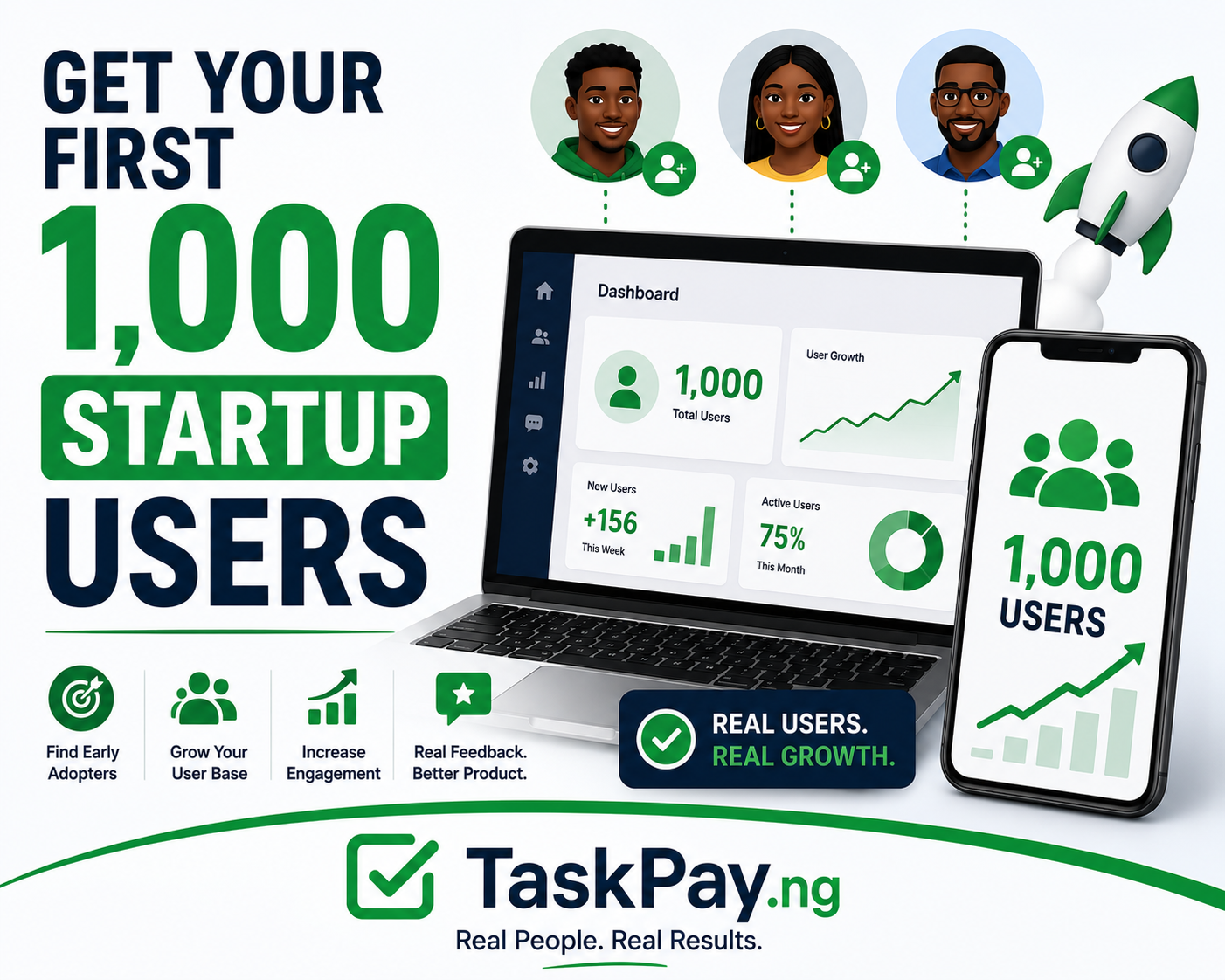
How to Get Your First 1,000 Users for a Startup in Nigeria
Getting your first users can be one of the hardest parts of building a startup.
You may have developed an excellent app, website or digital service, but without users, it's difficult to know whether you've built something people actually want.
Your first 1,000 users are particularly important. They can help you identify problems, improve your product and discover which marketing channels are worth scaling.
If you're building a startup in Nigeria, here are practical ways to find your first 1,000 users.
1. Define Your Ideal User
Don't start by trying to reach everybody.
Ask:
Who has the problem my startup solves?
For example, if you've built software that helps Nigerian restaurants manage deliveries, your initial target shouldn't be "everyone in Nigeria."
It should be restaurant owners and managers who need better delivery management.
The more specific your target audience is, the easier it becomes to find your first users.
2. Start With 10 Users, Not 1,000
Thinking about 1,000 users can feel overwhelming.
Start with 10.
Find 10 people who genuinely need your product and watch how they use it.
Ask:
- What confused them?
- Which feature did they use most?
- Why did they register?
- What nearly made them leave?
- Would they use the product again?
Fix the biggest problems before trying to attract hundreds of additional users.
3. Find Early Users With TaskPay
When you need real people to interact with a new digital product, TaskPay.ng can provide another way to recruit participants.
Businesses can create clearly defined microtasks for legitimate activities such as:
- Product testing
- Website testing
- App testing
- User research
- Onboarding testing
- Feature testing
- Surveys
- Product feedback
For example, you could create:
Task: Test Our New Business App and Give Feedback
Participants could be asked to register, test selected features and answer questions about their experience.
Instead of simply chasing registration numbers, use your early users to learn how people actually experience your startup.
4. Go Where Your Target Users Already Are
You don't need to create an audience from scratch.
Find communities where your potential users already spend time.
Depending on your startup, these could include:
- WhatsApp groups
- Facebook groups
- Telegram communities
- X
- Industry communities
- University communities
- Professional associations
Don't enter a community and immediately spam your registration link.
Participate, provide value and explain how your product solves a relevant problem.
5. Create Useful Content
Content marketing can bring potential customers to your startup without paying for every click.
Suppose you've created an accounting app for Nigerian small businesses.
You could publish articles such as:
How to Track Business Expenses in Nigeria
Simple Bookkeeping Guide for Nigerian Small Businesses
How to Calculate Profit for a Small Business
People searching for those problems are also potential users of your product.
Useful content can continue generating traffic months after publication.
6. Use Social Media
Show people what your product does.
Create short demonstrations for platforms such as Instagram, TikTok, Facebook, X and LinkedIn.
Don't simply announce:
"We launched a new app!"
Show a real problem.
Then demonstrate how your startup solves it.
People care more about what your product can do for them than the fact that you've launched it.
7. Build a Referral Programme
Once you have satisfied users, encourage them to invite others.
For example:
Invite a friend and receive a reward after they complete a qualifying action.
Referral programmes work particularly well when both the existing user and the new user receive something valuable.
Keep the process simple and clearly explain the conditions.
Also ensure that any referral campaign complies with the rules of the service or programme involved.
8. Work With Micro-Influencers
You don't necessarily need a celebrity.
Find smaller creators whose followers closely match your ideal customers.
A startup selling software to Nigerian entrepreneurs may benefit more from a business creator with 20,000 engaged followers than an entertainment celebrity with millions of unrelated followers.
Focus on audience relevance, not just follower count.
9. Offer Early-User Benefits
Give people a reason to try a new product.
You could offer:
- Free trial
- Early-access pricing
- Extra features
- Limited launch discount
- Founding-member benefits
The offer should encourage people to experience your product without creating an unsustainable cost for your business.
10. Make Onboarding Extremely Simple
You've finally convinced someone to try your startup.
Don't lose them during registration.
Remove unnecessary steps.
If users must complete 15 fields before seeing your product, many will leave.
Ask only for information you genuinely need.
Then help users reach the product's main benefit as quickly as possible.
11. Talk to Your First Users
Early-stage founders sometimes spend too much time looking at dashboards and not enough time speaking to users.
Your first 100 users are a valuable source of information.
Ask them:
Why did you sign up?
What problem were you trying to solve?
What almost stopped you from registering?
Which feature matters most?
Would you recommend the product?
Their answers can influence your product and marketing strategy.
12. Use Paid Advertising Carefully
Advertising can help you scale, but don't rush into large campaigns.
Start small.
Test different messages and audiences.
Track your customer acquisition cost.
If you're spending ₦5,000 to acquire a user who generates only ₦1,000 in value, increasing your advertising budget won't solve the problem.
First find a channel that works.
Then scale it.
13. Measure Active Users, Not Just Registrations
A startup announcing "10,000 registered users" sounds impressive.
But how many are actually using the product?
Track metrics such as:
Activation: Did the user complete an important first action?
Retention: Did they return?
Engagement: Are they using important features?
Conversion: Are free users becoming customers?
Referral: Are users inviting others?
One thousand active users can be more valuable than 50,000 registrations that never return.
A Simple Path to Your First 1,000 Users
Instead of treating 1,000 users as one huge target, break it down.
First 10: Personal outreach and intensive testing.
10–100: Communities, early adopters and product testing.
100–500: Content, referrals, partnerships and targeted promotion.
500–1,000: Scale the channels already producing quality users.
This approach lets you learn before spending heavily.
How TaskPay Can Help Startups
TaskPay can help startups connect with real Nigerians for clearly defined digital activities.
You can create tasks for:
- Beta testing
- Website testing
- App testing
- Market research
- Surveys
- User feedback
- Feature testing
- Product research
You determine the instructions, number of participants, proof requirements and reward.
For an early-stage startup, this can provide a practical way to get a product in front of real people and learn from their experience.
Final Thoughts
Your first 1,000 users probably won't arrive from one viral post.
They'll come from understanding your audience, speaking to early users, improving your product and gradually discovering which acquisition channels work.
Don't focus only on making your registration counter bigger.
Focus on finding people who genuinely need what you've built.
If you need real Nigerians to test your startup, participate in research or complete legitimate digital tasks, TaskPay.ng can help you reach them.
Find your first users. Learn from them. Then scale what works.
Visit TaskPay.ng and create your startup campaign today.