
How to Get Real People to Review and Give Feedback on Your Product in Nigeria
You've launched a new product.
Maybe it's an app, website, online service, digital tool or a new feature for your existing business.
Now you need to know something important:
What do real people actually think about it?
Friends and employees may tell you everything looks great. Real customers may have a completely different experience.
Getting genuine product feedback can help you discover confusing features, technical problems, missing functionality and reasons potential customers aren't converting.
If you're looking for real people to test and review your product in Nigeria, here are practical ways to find them.
1. Decide What You Want to Learn
Don't simply ask:
"What do you think about my product?"
That's too broad.
Decide what information you need.
For example:
- Is the product easy to understand?
- Is registration straightforward?
- Which feature is most useful?
- Is anything confusing?
- Does the product solve the intended problem?
- Would someone actually use it?
- What would make the product better?
Specific questions produce better feedback.
2. Find People Who Match Your Target Customer
Not everyone should test every product.
Suppose you've built an invoicing tool for Nigerian small businesses.
Feedback from business owners may be much more useful than feedback from people who have never needed to create an invoice.
Define your ideal tester.
Consider factors such as:
- Age group
- Occupation
- Location
- Interests
- Business type
- Device
- Experience with similar products
The closer testers are to your target customers, the more relevant their feedback may be.
3. Use TaskPay to Recruit Product Testers
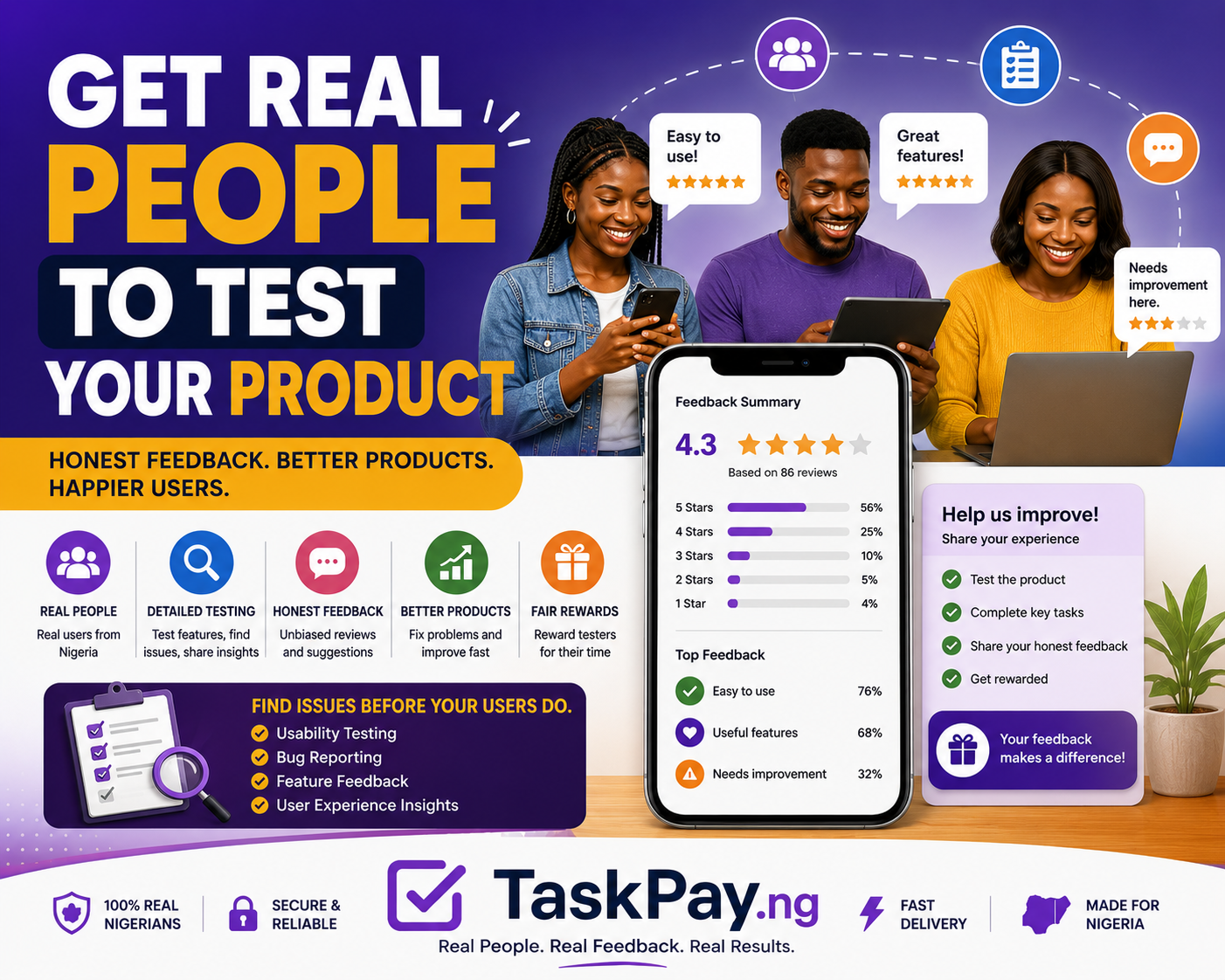
If you need more testers than you can find through your personal network, TaskPay.ng can help you recruit real Nigerians for structured product-testing tasks.
For example:
Task: Test Our New App and Give Honest Feedback
Participants could be asked to:
- Access the product.
- Create an account.
- Test selected features.
- Complete a specific activity.
- Report any problems.
- Answer feedback questions.
You determine how many testers you need, the instructions, required proof and reward.
The objective should be genuine testing and honest feedback, not paying people to say positive things.
4. Ask for Honest Feedback, Not Positive Feedback
This distinction is extremely important.
Don't tell testers:
"Give us a 5-star review."
Instead ask:
"Tell us honestly what worked and what didn't."
Negative feedback can sometimes be more valuable than praise.
If ten people complain about the same registration screen, you've probably found something worth fixing.
You're paying participants for their time and effort—not for a particular opinion.
5. Use Surveys for Structured Feedback
Surveys can help you compare responses across many testers.
After someone uses your product, ask questions such as:
How easy was registration?
Which feature did you find most useful?
What was confusing?
Did you encounter any technical problems?
How likely are you to use the product again?
You can combine multiple-choice questions with open-ended questions.
This gives you both measurable data and detailed comments.
6. Conduct Usability Testing
Usability testing focuses on watching whether people can successfully use your product.
Give someone a task without explaining how to complete it.
For example:
"Create an account and find the withdrawal page."
Then see whether they can do it.
If several users struggle, the problem may be your interface—not the users.
This type of testing is particularly useful for websites and mobile apps.
7. Recruit Through Social Media
You can also find testers through social media.
Post on:
- X
- Relevant online communities
Be specific about who you need.
For example:
"We're looking for 20 Nigerian online sellers to test a new inventory tool and provide feedback."
That is much more targeted than:
"Who wants to test my website?"
8. Ask Existing Customers
Your current customers can be excellent product testers.
They already understand the problem your business solves.
If you're introducing a new feature, invite some existing customers to try it before the wider launch.
Ask them:
- Is this useful?
- Is anything missing?
- Is it easier than the old process?
- Would you actually use it?
Customer feedback can help you avoid building features nobody needs.
9. Test With New Users Too
Existing customers are useful, but they already understand your business.
New users provide a different perspective.
Ask someone who has never seen your product to use it.
Can they understand what it does?
Can they register without help?
Can they find the main feature?
Can they understand the pricing?
A new user's confusion may reveal problems your regular customers no longer notice.
10. Reward People Fairly for Their Time
Good product testing takes effort.
Someone spending 20 minutes testing several features and writing detailed feedback is providing valuable work.
Set a reasonable reward based on:
- Time required
- Number of steps
- Complexity
- Amount of feedback requested
Better task instructions and appropriate compensation can help encourage more thoughtful participation.
11. Look for Patterns in the Feedback
Don't redesign your entire product because one person dislikes a button.
Look for repeated problems.
For example:
Tester 1: Couldn't find the pricing page.
Tester 2: Didn't understand the menu.
Tester 3: Couldn't find pricing.
Tester 4: Pricing was easy to find.
Now you have a possible navigation issue worth investigating.
Patterns are often more useful than individual opinions.
12. Test Again After Making Changes
Product testing shouldn't happen only once.
Use a simple cycle:
Test → Collect feedback → Fix problems → Test again
After making improvements, recruit another small group.
Don't tell them what previous testers struggled with.
See whether the problem occurs naturally again.
Product Feedback vs Public Reviews
These are not the same thing.
Product feedback is information collected to help improve your product.
A public review is an opinion posted publicly on a review platform, app store or marketplace.
Businesses should never use paid participants to create deceptive positive reviews or artificially inflate ratings.
If you're using TaskPay, focus on legitimate activities such as:
- Private product feedback
- User testing
- Surveys
- Bug reporting
- Usability testing
- Customer research
Public reviews should reflect genuine customer experiences and comply with the rules of the platform where they're posted.
How Many Product Testers Do You Need?
You don't always need hundreds.
Start with a small group.
Even 5–10 suitable testers may uncover major usability problems.
Fix those problems.
Then test with another group.
For broader research, you can gradually increase the number of participants.
The right number depends on your product and what you're trying to learn.
How TaskPay Can Help With Product Testing
TaskPay allows employers to turn product-testing requirements into clearly defined microtasks.
You can specify:
Who should participate
What they need to test
Which questions they should answer
What evidence they should provide
How many participants you need
How much they'll receive
This can be particularly useful for startups and businesses that need feedback from real Nigerian users without relying entirely on friends and employees.
Final Thoughts
Don't wait until hundreds of customers complain before testing your product.
Put it in front of real people early.
Ask them to complete specific activities and encourage honest feedback.
Then pay attention to repeated problems.
The goal isn't to collect compliments.
The goal is to discover what you can improve before those problems cost you customers.
If you need real Nigerians to test your app, website or digital product and provide genuine feedback, TaskPay.ng gives you a practical way to recruit participants through clearly defined tasks.
Real users. Honest feedback. Better products.
Visit TaskPay.ng and create your product-testing task today.