How to Get More Referral Sign-Ups in Nigeria
Referral programmes can be an effective way to earn rewards or grow a business, but there's usually one major challenge:
Getting people to actually sign up.
You may have shared your referral link on WhatsApp, sent it to friends and posted it on social media, yet you're still getting very few registrations.
If you're trying to get more referral sign-ups in Nigeria, simply sharing your link more often isn't necessarily the answer.
You need to reach the right people, explain the offer clearly and make it easy for interested users to complete the process.
Here are practical ways to improve your referral results.
1. Explain the Benefit Clearly
People need a reason to register.
Don't make your promotional message entirely about what you receive.
Instead of:
"Please use my referral link so I can earn a bonus."
explain why the service may be useful to the new user.
If the referral programme also gives new users a legitimate bonus or benefit, explain it clearly.
For example:
"New users who register through this referral offer may qualify for [benefit] after completing the required steps."
Always state the actual conditions.
Don't promise rewards that aren't guaranteed.
2. Target People Who Actually Need the Product
One of the biggest referral-marketing mistakes is trying to reach everyone.
Imagine you're promoting a business-accounting app.
Would you rather show your referral link to 10,000 random people or 1,000 small-business owners?
The smaller targeted audience may produce far more registrations.
Think about:
- Who needs this service?
- What problem does it solve?
- Where do those people spend time online?
- Why would they register?
Targeting improves both sign-ups and the quality of referrals.
3. Check the Referral Programme's Rules
Before promoting your referral link, read the programme terms carefully.
Some referral programmes allow public promotion. Others restrict certain methods, including incentivised sign-ups or paid promotion.
Check whether the programme permits:
- Public referral links
- Paid promotion
- Incentivised registrations
- Social media advertising
- Referral-code websites
- Promotional campaigns
Never try to bypass these restrictions.
If your referrals violate the programme's terms, they may be rejected and your account could potentially be affected.
4. Create Helpful Content
Useful content can generate referral sign-ups without repeatedly asking people to register.
Suppose you're promoting a financial app.
You could create articles or videos such as:
How to Use [App] in Nigeria
How to Create an Account on [App]
[App] Review for Nigerian Users
How [Feature] Works
Someone searching for this information already has some interest in the product.
Include your referral link naturally and disclose that you may receive a benefit if someone registers through it.
5. Use Social Media Strategically
Social media can expose your referral offer to more people.
Depending on the product, consider:
- TikTok
- X
Avoid posting your referral link repeatedly without context.
Instead, explain what the product does.
For example:
Problem → Solution → Benefit → Referral link
That structure is more persuasive than simply saying:
"Register here."
6. Use TaskPay Where Referral Incentives Are Allowed
When a referral programme permits incentivised participation, TaskPay.ng can provide another way to reach real Nigerians.
An employer can create a clearly defined referral task explaining:
- What the service is
- Who qualifies
- What participants need to do
- What counts as successful completion
- Required proof
- Reward per completed task
For example, where the third-party programme permits it:
Task: Register Through Our Referral Link and Complete the Required Onboarding
This allows employers to define the campaign requirements and number of participants needed.
However, always check the referral programme's terms first.
TaskPay should not be used to circumvent another platform's rules.
7. Promote Through WhatsApp Status
Your WhatsApp Status can be a simple way to introduce referral offers to people who already know you.
Instead of posting only a link, create several status updates.
For example:
Status 1: Explain the problem.
Status 2: Introduce the product.
Status 3: Explain the benefit.
Status 4: Share your referral link.
This gives people context before asking them to register.
8. Create Short Video Tutorials
Short videos can help people understand unfamiliar products.
Show:
- How the service works
- How to register
- Important features
- What new users should expect
- How to complete qualifying steps
You can publish these videos on TikTok, Instagram, Facebook or YouTube.
Educational videos can build more trust than repeatedly posting referral links.
9. Make Registration Instructions Simple
Some people click a referral link but don't complete registration.
They may become confused during onboarding.
Create simple instructions such as:
Step 1: Open the referral link.
Step 2: Create your account.
Step 3: Complete the required verification.
Step 4: Complete the qualifying action.
Only include steps genuinely required by the programme.
The easier the process is to understand, the fewer potential users you may lose.
10. Promote in Relevant Communities
Find online communities related to the product you're promoting.
These might include:
- WhatsApp communities
- Facebook groups
- Telegram groups
- Professional communities
- Student communities
- Business groups
Always check the community's rules before posting referral links.
Don't spam unrelated groups.
A referral offer works best when it's genuinely relevant to the audience.
11. Build Trust
People may hesitate to register for unfamiliar services.
Give them enough information to make their own decision.
Explain:
- What the company does
- What information registration requires
- Whether verification is required
- What conditions apply to rewards
- Where they can read the official terms
Never hide important requirements simply to increase sign-ups.
Trust produces better long-term results.
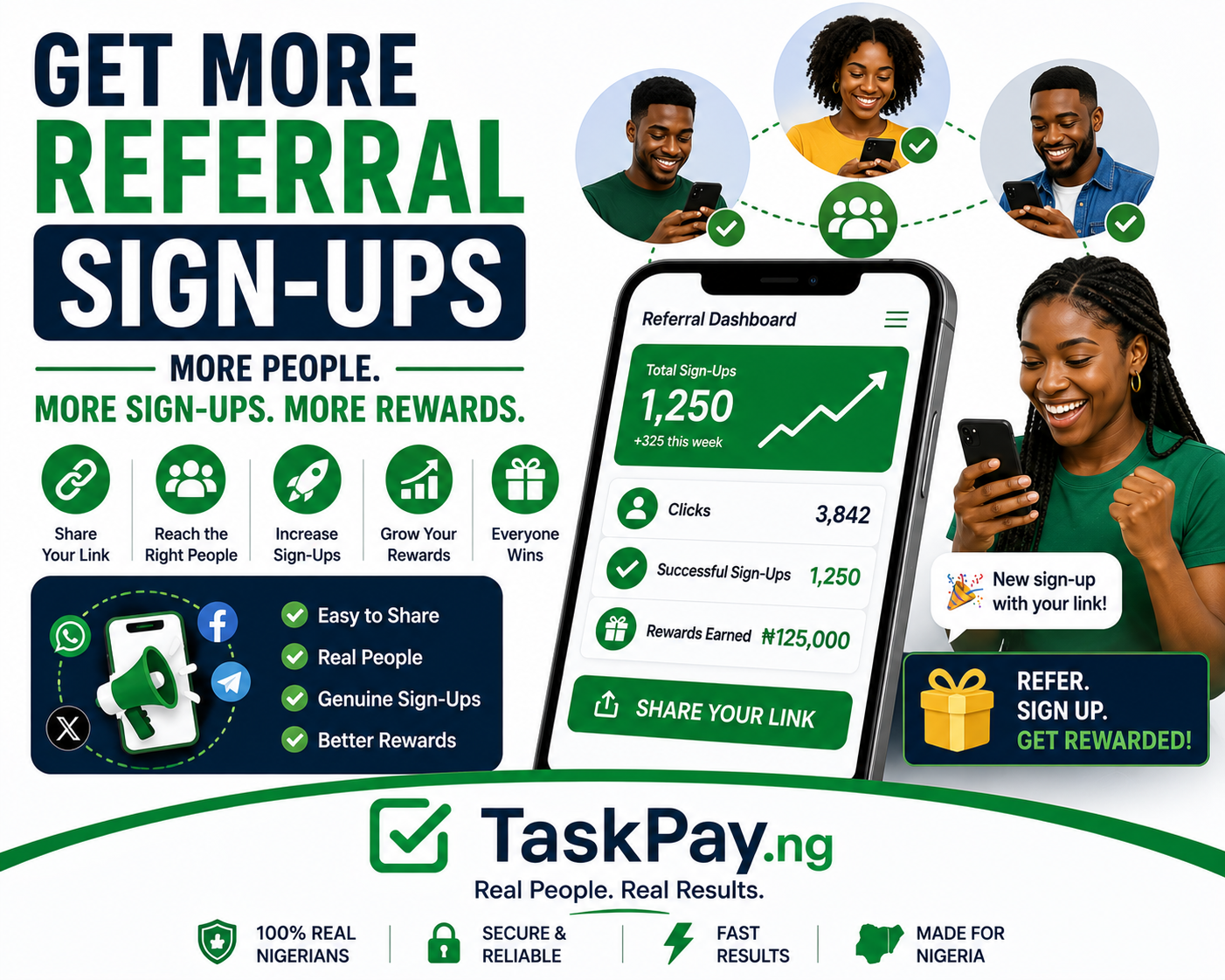
12. Track Referral Conversions
Don't focus only on link clicks.
Track the entire process where the referral programme provides this information.
For example:
100 people clicked
40 registered
25 completed verification
15 completed the qualifying action
Now you know where people are dropping out.
If many click but few register, your landing page or offer may need improvement.
If many register but don't complete onboarding, the process may be confusing.
Referral Sign-Ups vs Quality Referrals
More isn't always better.
A referral programme may reward only users who complete specific qualifying actions.
That means 500 incomplete registrations may be worth less than 50 genuine active users.
Focus on finding people who actually have a reason to use the product.
Those users are more likely to complete registration and continue using the service.
How TaskPay Can Support Referral Campaigns
TaskPay connects employers with real Nigerians who complete clearly defined digital tasks.
Where a third-party referral programme permits incentivised participation, employers may be able to use TaskPay to organise legitimate referral campaigns.
TaskPay can also support related activities such as:
- Product awareness
- User research
- App testing
- Website testing
- Surveys
- Promotional feedback
- Onboarding testing
Always ensure the activity complies with the rules of the company or platform being promoted.
Final Thoughts
Getting more referral sign-ups isn't about dropping your link into as many places as possible.
Successful referral marketing starts with a useful product, relevant audience and clear explanation of the benefits.
Create helpful content, use social media strategically, simplify registration and track which promotional channels actually generate qualified users.
And where incentivised referrals are explicitly permitted, TaskPay.ng can help you connect with real Nigerians through clearly defined digital tasks.
More relevant people. Better referrals. Better results.
Visit TaskPay.ng to explore legitimate referral and digital campaign opportunities.